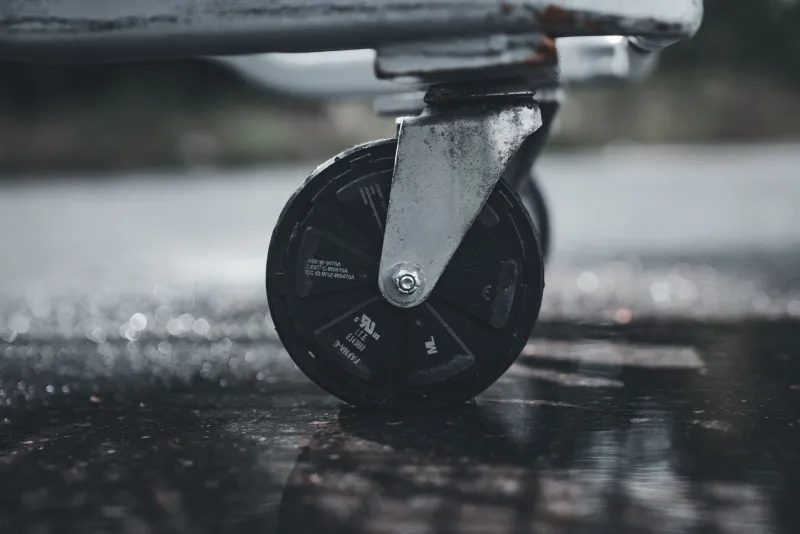
Built to Be Pushed, Now Being Towed: Why Powered Equipment Is Breaking Manual-Rated Casters
Walk through any newly automated distribution center and you'll notice a pattern: carts designed a decade ago for human hands are now hitched in trains behind electric tuggers. The economics made sense on paper—fewer associates, more payload per trip. What the conversion plans rarely accounted for was what happens to a caster when it stops being pushed and starts being towed.
The result, reported again and again by maintenance teams, is the same: casters that lasted three years under manual duty failing in eight to ten months under tow. This isn't bad luck or defective product. It's physics that most caster spec sheets were never written to address.
Push Forces vs. Tow Forces: Not the Same Math
When an associate pushes a cart, force enters the system through the cart frame and distributes relatively gently through four casters, at walking speed, with a human's instinctive corrections for wobble and drift.
Towing changes every variable. The tugger pulls the lead cart, the lead cart pulls the second, and so on down the train. That last cart in a four-cart train absorbs the accumulated tow-line tension plus its own rolling resistance. Meanwhile, the tow hitch introduces lateral forces every time the train turns—the lead cart cuts a different arc than the trailing carts, forcing their casters into sideslip the wheels were never rated for.
The practical consequence: a cart rated for 1,200 pounds under hand pushing may see effective caster loads 30–50% higher at the rear of a tow train, with dynamic side-loading on top.
Flutter: The Failure Mode Nobody Budgets For
Ask tow-train operators about their biggest complaint and the word you'll hear is flutter—the violent, self-sustaining side-to-side oscillation of swivel casters at speed.
Flutter emerges when towing speed exceeds a caster's swivel stability threshold. Hand-pushed carts rarely exceed 3 mph, and a human operator's grip dampens wobble naturally. A tugger moving at 6–8 mph removes both constraints. Once flutter begins, each oscillation hammers the swivel bearings, races, and seals. Bearings brinell. Seals fail. Debris ingress accelerates everything. A caster in chronic flutter can be structurally dead within weeks.
Speed Ratings: The Spec That Isn't There
Here's the uncomfortable truth: many caster spec sheets list load capacity but no maximum speed, because the traditional manual-handling market didn't demand one. Casters genuinely engineered for powered towing publish speed ratings—often in the 6–10 mph range—and back them with swivel designs built for it: precision thrust bearings, offset crowns, larger swivel radii, and in demanding applications, independently steerable or secured swivel configurations.
If a supplier can't tell you a wheel's rated towing speed, that wheel wasn't designed for your application.
The Contamination Multiplier
Tow trains also change the traffic pattern. Trains run fixed routes, repeatedly, at consistent speeds—meaning casters cross the same floor defects, the same debris fields, the same dock transitions dozens of times per shift. A joint strike that a hand-pushed cart absorbs once an hour becomes a hammering cycle repeated hundreds of times daily. Wheel material and diameter that seemed adequate for intermittent traffic reveal their limits fast under sustained duty.
A Buyer's Checklist for Tow-Rated Casters
Before specifying casters for any towed application, confirm every item on this list:
- Published speed rating at or above your tugger's top operating speed, with margin.
- Tow-line load calculation, not just cart load—ask the supplier to help compute effective loads at each train position, especially the rear.
- Heavy-duty swivel construction: precision or sealed thrust bearings, hardened races, and swivel bearings rated for dynamic side loads.
- Flutter mitigation features, such as larger swivel offset, crown tread geometry, or the option for swivel locks on trailing positions.
- Wheel diameter sized for your route's worst obstacles, since repeated strikes at speed amplify impact damage.
- Sealed, maintenance-friendly bearings if trains run through wash-down zones or debris-heavy aisles.
- Braking and securing provisions compatible with automated stops—trains that park unattended need positive wheel locks, not swivel locks alone.
- A documented failure history from the supplier in comparable towing applications. References matter more than catalog claims.
Retrofitting the Fleet You Already Have
If you've already converted to tuggers and are chasing premature failures, don't just replace like-for-like. Audit the train configuration first: position of heaviest loads, tow speeds, route surfaces, and corner radii. Often a modest change—moving weight forward in the train, dropping tow speed by 1 mph, or upsizing rear-position wheels—extends life dramatically. Then spec replacement casters against the towed reality, not the cart's original nameplate.
Powered material movement isn't a trend; it's the direction of American logistics. The facilities that thrive will be the ones whose rolling hardware was specified for the forces actually acting on it—not the forces the catalog assumed.