Hot Days, Cold Nights, and Cracked Wheels: Protecting Casters in Thermally Volatile Environments
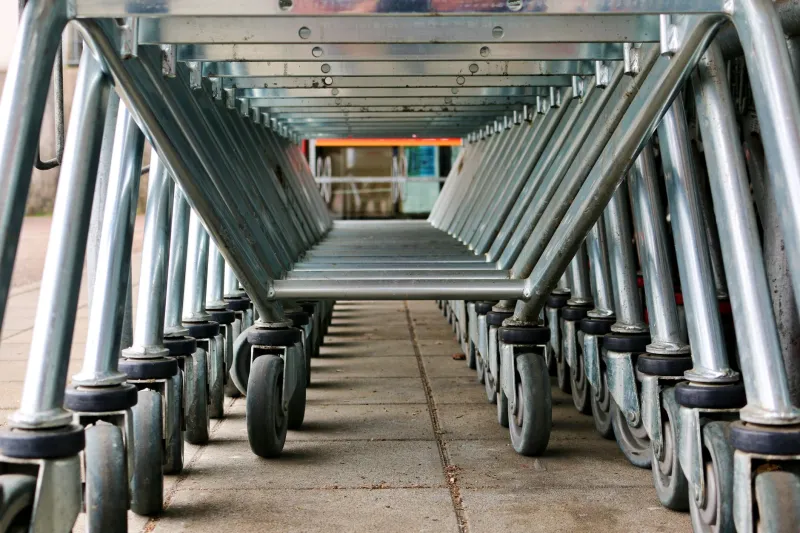
A distribution center in the Midwest runs its receiving dock at ambient temperature year-round. In January, that means carts are staged outside in single-digit Fahrenheit conditions before being wheeled into a heated interior at sixty-five degrees. In July, the same carts move from an air-conditioned storage area to an asphalt staging yard where surface temperatures can exceed one hundred and twenty degrees. The casters on those carts are experiencing a thermal range of well over one hundred degrees Fahrenheit—sometimes within the same shift.
This is not an edge case. It describes the operational reality of tens of thousands of facilities across the United States: cold-storage operations, seasonal fulfillment centers, manufacturing plants with outdoor staging areas, food processing facilities, and agricultural operations that transition between climate-controlled and uncontrolled environments as a routine part of daily work.
The casters on equipment in these environments are failing faster than their rated service life would suggest. In most cases, the cause is never correctly identified.
What Thermal Cycling Actually Does to Wheel Materials
The term "thermal cycling" refers to repeated transitions between high and low temperatures. For caster wheels, these transitions create stress at the material level through two primary mechanisms: differential thermal expansion and polymer chain degradation.
Differential thermal expansion occurs when different materials in a caster assembly—the wheel core, the tread material, the bearing housing, and the fastening hardware—expand and contract at different rates as temperature changes. Over dozens or hundreds of cycles, this differential creates micro-stress fractures at the interfaces between materials. A polyurethane tread bonded to a polypropylene core, for example, will experience shear stress at the bond line every time the temperature swings significantly. Eventually, that bond fails.
Polymer chain degradation is a slower process but no less destructive. Many common wheel materials—polyurethane, rubber compounds, nylon—are polymers whose molecular structure is sensitive to temperature extremes. Repeated exposure to sub-freezing temperatures causes polymer chains to stiffen and become brittle. Repeated exposure to high temperatures causes softening, deformation under load, and accelerated oxidative breakdown. A wheel that cycles between these extremes does not simply age at the average of the two conditions—it ages at an accelerated rate that reflects the cumulative stress of each transition.
The Humidity Complication
Temperature does not operate in isolation. Humidity compounds thermal stress in ways that are frequently overlooked in caster selection.
When a cold cart is moved into a warm, humid environment, condensation forms on and within the caster assembly. That moisture penetrates bearing seals, promotes rust on steel components, and accelerates the breakdown of lubricants. When the cart is returned to a cold environment, any residual moisture freezes, expanding within bearing races and causing damage that presents as premature bearing failure rather than moisture intrusion.
Facilities that operate cold-storage equipment in humid climates—the Gulf Coast, the Pacific Northwest, the Great Lakes region—are particularly susceptible to this failure mode. Standard bearing seals are not rated for repeated freeze-thaw cycles, and standard lubricants lose viscosity at low temperatures in ways that leave bearing surfaces inadequately protected.
Misdiagnosis and Its Consequences
Because thermally driven caster failure does not announce itself with an obvious cause, it is almost always attributed to something else: overloading, floor surface damage, or simply "defective" product. Maintenance teams replace the failed component with the same specification, and the cycle repeats.
This misdiagnosis has two significant consequences. First, it prevents the facility from addressing the actual failure mechanism, guaranteeing continued premature wear. Second, it distorts procurement data, making thermally volatile environments appear to have abnormally high caster consumption without a clear explanation—which, in turn, makes it harder to justify the investment in higher-specification components.
Material Selection for Thermally Volatile Environments
The good news is that thermally volatile environments are not an unsolvable problem. They require more deliberate material selection, but appropriate options are available at practical price points.
For sub-freezing environments: Phenolic wheels and glass-filled nylon cores maintain structural integrity at low temperatures better than standard polyurethane or rubber compounds. Stainless steel fasteners and corrosion-resistant bearing seals are essential for operations that involve moisture exposure. Lubrication should be rated for low-temperature performance—standard greases thicken significantly below freezing and may cease to provide adequate film protection.
For high-heat environments: High-temperature polyurethane formulations and cast iron wheels are appropriate for applications where floor surface temperatures are elevated. Standard polyurethane softens at temperatures above approximately one hundred and sixty degrees Fahrenheit; high-temperature variants extend that threshold considerably. For extreme heat applications—near furnaces, autoclaves, or outdoor staging areas in southern climates during summer—steel or cast iron wheels with high-temperature grease-packed bearings are the appropriate specification.
For wide thermal ranges: The most challenging specification is not the extreme cold or the extreme heat—it is the facility that regularly experiences both. In these environments, stainless steel hardware, sealed precision bearings, and wheel materials with low coefficients of thermal expansion are the foundation of a durable specification. Thermoplastic rubber (TPR) compounds with stabilized polymer formulations offer a reasonable balance of flexibility across a wide temperature range, though they should be evaluated against the specific temperature extremes of the application.
Maintenance Adjustments for Thermal Environments
Material selection alone is not sufficient. Maintenance protocols must also account for the thermal environment.
Bearing lubrication intervals should be shortened for equipment that operates in wide thermal ranges, as lubricant breakdown is accelerated by repeated temperature transitions. Visual inspection protocols should include specific attention to wheel surface cracking and tread delamination—early indicators of thermal fatigue that precede structural failure. Equipment that has been stored in sub-freezing conditions should be inspected before being returned to service, as cold-soaked wheels may be temporarily brittle and susceptible to impact fracture.
A Note on Specification Documentation
Facilities with thermally volatile environments should document their thermal operating range as a formal parameter in their caster specifications—just as they would document load capacity or floor surface type. This single step ensures that future procurement decisions account for the thermal environment rather than defaulting to a general-purpose specification that was never designed to perform under those conditions.
Casters are not passive components. They respond to their environment in ways that are predictable, manageable, and—with the right specification—entirely preventable. The facilities that understand this spend less time replacing failed wheels and more time moving product.