Equipment Carts That Refuse to Die: Breaking the Cycle of Stranded Assets on Your Facility Floor
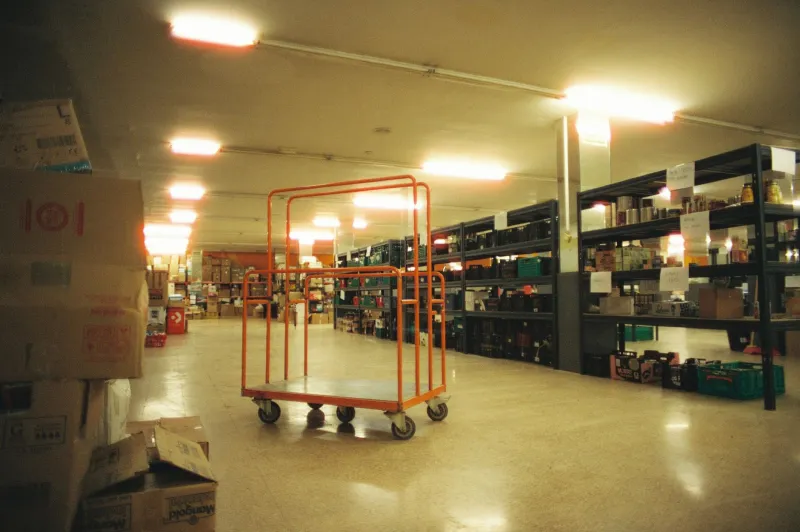
Walk through almost any large warehouse or manufacturing plant in the United States and you will find them: carts pushed against a wall, tucked behind a rack, or parked at the far end of a loading dock. Some are missing a wheel. Some wobble conspicuously when moved. Some have been wrapped in caution tape so long that the tape itself has begun to deteriorate. These are the facility's stranded assets—equipment that has long since stopped earning its floor space but has, through a combination of inertia, competing priorities, and organizational ambiguity, become as permanent as the building's columns.
The phenomenon has a recognizable pattern. A cart develops a caster problem—a cracked wheel, a seized swivel, a mounting plate that has pulled loose from the frame. Someone moves it out of the active workflow. A handwritten note or a verbal understanding marks it as "broken" or "needs repair." And then, very often, nothing else happens. Weeks pass. The cart is worked around. It is occasionally moved to accommodate other operations, but it is never repaired and never removed. Over time, it becomes invisible to the people who pass it every day.
Facility managers who have confronted this pattern describe it with a mixture of frustration and recognition. The carts accumulate gradually, which makes the problem difficult to perceive until it has become significant. By the time someone takes a deliberate count, a facility may have dozens of non-functional carts consuming hundreds of square feet of usable space.
Why Broken Carts Stay Broken
The persistence of stranded equipment carts is not primarily a maintenance failure—it is an organizational one. Several structural factors conspire to keep these assets in place long after they have outlived their usefulness.
Ownership ambiguity is among the most common. In facilities where carts circulate across departments, shifts, or zones, no single person or team feels clearly responsible for a broken unit. Maintenance may defer to operations; operations may defer to a supervisor who has other priorities. Without an assigned owner, the cart waits indefinitely for someone to claim the problem.
Repair optimism plays an equally significant role. A cart with a single failed caster is, in principle, an easy fix. Someone intends to address it. That intention, however genuine, competes with daily production demands, staffing constraints, and the simple fact that working equipment always commands more immediate attention than broken equipment. The repair that seems straightforward in the abstract gets deferred in practice, again and again.
Disposal friction compounds the issue. Even when a cart is acknowledged as beyond economic repair, removing it from the facility requires decisions that no one is eager to make. Does it go to salvage? Surplus? Scrap? Who authorizes the write-off? Who arranges the removal? In facilities without a clear disposition process, the path of least resistance is to leave the cart where it is.
The Costs That Don't Appear on an Invoice
Stranded equipment carts impose costs that are real but rarely captured in standard accounting. The most immediate is floor space. A single cart occupies between fifteen and thirty square feet, depending on its dimensions. A facility with twenty stranded carts may have surrendered four hundred to six hundred square feet of usable space—an area that could otherwise serve as staging, storage, or a dedicated workflow lane.
The operational drag extends beyond square footage. Workers navigate around broken carts, adding unnecessary steps to routine tasks. In facilities where space is already constrained, these detours accumulate into meaningful inefficiency over the course of a shift. Supervisors who have measured this effect describe it as one of those costs that never appears on a budget report but shows up unmistakably in productivity data.
Safety exposure is the most serious concern. A cart with a failed caster does not behave predictably under load. It may tip, veer, or collapse in ways that a functional cart would not. Even a cart that is nominally out of service can be pressed back into use during a busy period, a shift change, or a staffing shortage—particularly if the "out of service" designation exists only as a verbal understanding rather than a documented and enforced status. OSHA's general duty clause requires employers to maintain a workplace free from recognized hazards; a broken cart that remains accessible on the floor is a recognized hazard by any reasonable standard.
A Practical Framework for Quarterly Cart Audits
The most effective counter to the stranded asset problem is a structured audit cycle that removes the ambiguity enabling these situations to persist. A quarterly cart audit does not require significant resources, but it does require clear criteria, assigned accountability, and a disposition process that is defined before the audit begins—not improvised during it.
Step one: Establish a complete cart inventory. Before any assessment can occur, the facility needs an accurate count of every cart on the floor, including those that are currently out of service. This inventory should include a unique identifier for each unit, its location, its general condition, and the department or zone responsible for it. Facilities that lack this baseline will find the first audit takes longer; subsequent audits are substantially faster.
Step two: Define condition criteria in advance. The audit loses its utility if condition assessments are left to individual judgment in the moment. A simple three-tier framework works well in practice: carts rated as serviceable require no immediate action; carts rated as repairable are tagged with a specific repair deadline and an assigned owner; carts rated as non-recoverable are flagged for immediate disposition. The threshold between repairable and non-recoverable should be defined in terms of repair cost relative to replacement cost—a figure that purchasing and maintenance can agree on before the audit begins.
Step three: Execute the disposition process without delay. The most common point of failure in cart audits is the gap between assessment and action. Carts flagged for repair need a work order created on the day of the audit, not sometime in the following weeks. Carts flagged for disposition need a removal date assigned immediately. If the disposition process requires a write-off authorization, that authorization should be built into the audit workflow rather than treated as a separate administrative step.
Step four: Address root causes, not just symptoms. A quarterly audit that consistently surfaces the same categories of failure—seized swivel casters, cracked wheels on a particular cart type, mounting plates that fail under load—is providing diagnostic information that should inform procurement and maintenance decisions. If a specific caster specification is failing prematurely under the conditions present in your facility, the audit findings justify a specification review. Replacing like-for-like on a cart that has failed twice is not a solution; it is a deferral.
Reclaiming the Floor
The stranded cart problem is, at its core, a symptom of systems that allow low-priority decisions to be deferred indefinitely. The carts themselves are not the issue—the issue is the absence of a mechanism that forces those decisions to be made on a defined schedule.
Facilities that implement structured audit cycles consistently report improvements that extend well beyond the carts themselves. The discipline required to maintain an accurate inventory, assign clear ownership, and follow through on disposition decisions tends to surface other deferred maintenance issues and organizational ambiguities that have been absorbing cost without appearing on any report.
The floor space recovered is real. The safety exposure reduced is real. And the operational clarity that comes from knowing that every cart on your floor is either functional or actively on its way to becoming functional is, for most facility managers, worth considerably more than the effort the audit requires.